Spray Foam vs. Blown-In Insulation: The Complete Cost & Performance Guide
If you've started researching insulation for your home, you've probably run into two names over and over: spray foam and blown-in insulation. Both get installed by professionals, both fill gaps that batts and rolls can't reach, and both show up on nearly every contractor's estimate sheet. But they are not interchangeable, and picking the wrong one for a given space can mean leaving real money on the table every single month for the next twenty years.
This guide is a straight, no-fluff comparison of how each material actually works, what it costs, how long it lasts, and — most importantly — which one belongs in which part of your house. We'll cover R-value per inch, air-sealing performance, realistic cost ranges, longevity, moisture behavior, and a decision framework you can use room by room. By the end, you should be able to walk into a conversation with a contractor already knowing what questions to ask.
The Short Answer, If You're in a Hurry
Spray foam air-seals and insulates in a single step, resists settling and moisture, and delivers more R-value per inch — but it costs more upfront. Blown-in insulation (fiberglass or cellulose) is cheaper per square foot, works well for open attic floors where depth isn't a constraint, but does not stop air movement on its own and can settle or compress over time. Neither material is universally "better." The right choice depends on the space, your budget, and what problem you're actually trying to solve — a drafty house needs a different fix than a house that's simply under-insulated.
How Spray Foam Insulation Actually Works
Spray polyurethane foam (SPF) starts as two liquid chemical components — typically labeled A and B — that get mixed at the tip of a spray gun under heat and pressure. The moment they combine, a chemical reaction kicks off: the mixture expands, rises, and cures into a solid, cellular plastic within seconds. That expansion is what makes spray foam different from every other insulation material on the market. It doesn't just fill a cavity — it grows into every crack, seam, wire penetration, and irregular gap in that cavity, then hardens in place. The result is a continuous, adhered air barrier and thermal barrier in one application.
Open-Cell vs. Closed-Cell Spray Foam
There are two distinct types of spray foam, and confusing them is one of the most common mistakes homeowners make when comparing bids.
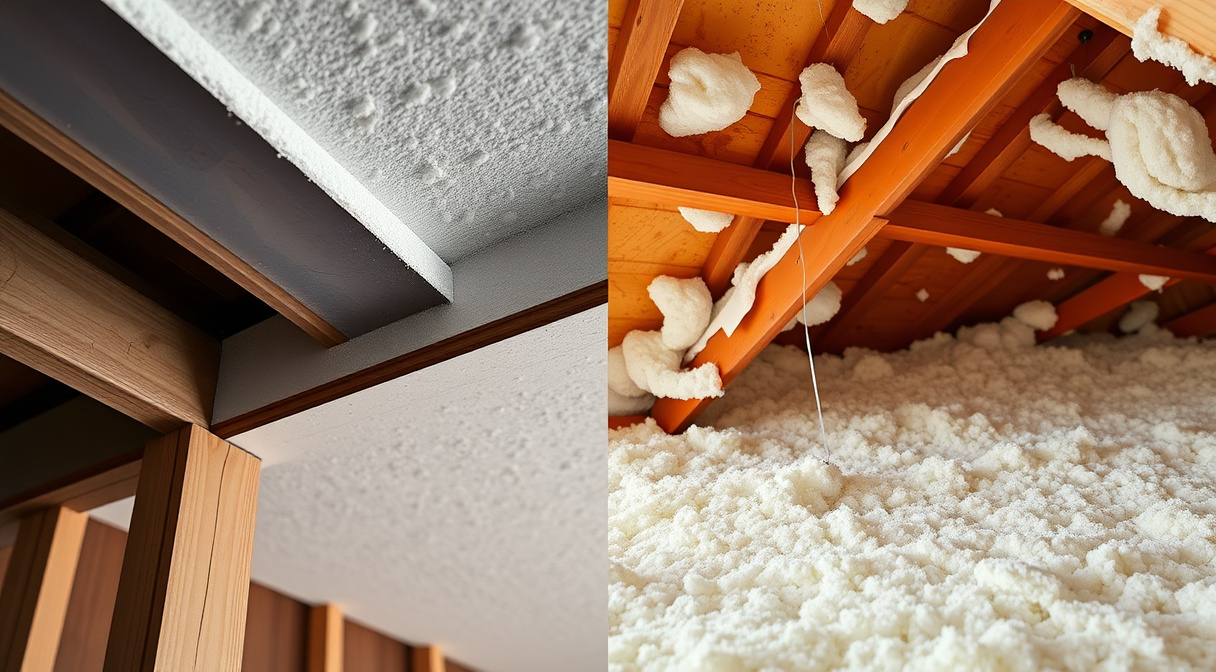
- Open-cell foam: Lighter, softer, and more affordable. The cell structure isn't fully sealed, so it stays somewhat vapor-permeable and expands more per pound of material — useful for filling large, irregular cavities like roof decks and interior walls. Typical R-value is roughly R-3.5 to R-3.7 per inch.
- Closed-cell foam: Denser, rigid, and roughly twice the R-value per inch of open-cell — typically R-6 to R-7 per inch. The tightly packed cell structure makes it a vapor retarder and adds real structural rigidity to the cavity it fills, which is why it's the standard choice for rim joists, crawl spaces, and below-grade applications where moisture exposure is a bigger concern.
Both types adhere permanently to the substrate they're sprayed onto — wood framing, subfloor, masonry — which is a fundamentally different mechanism than any insulation that simply sits in a cavity by gravity or friction.
How Blown-In Insulation Actually Works
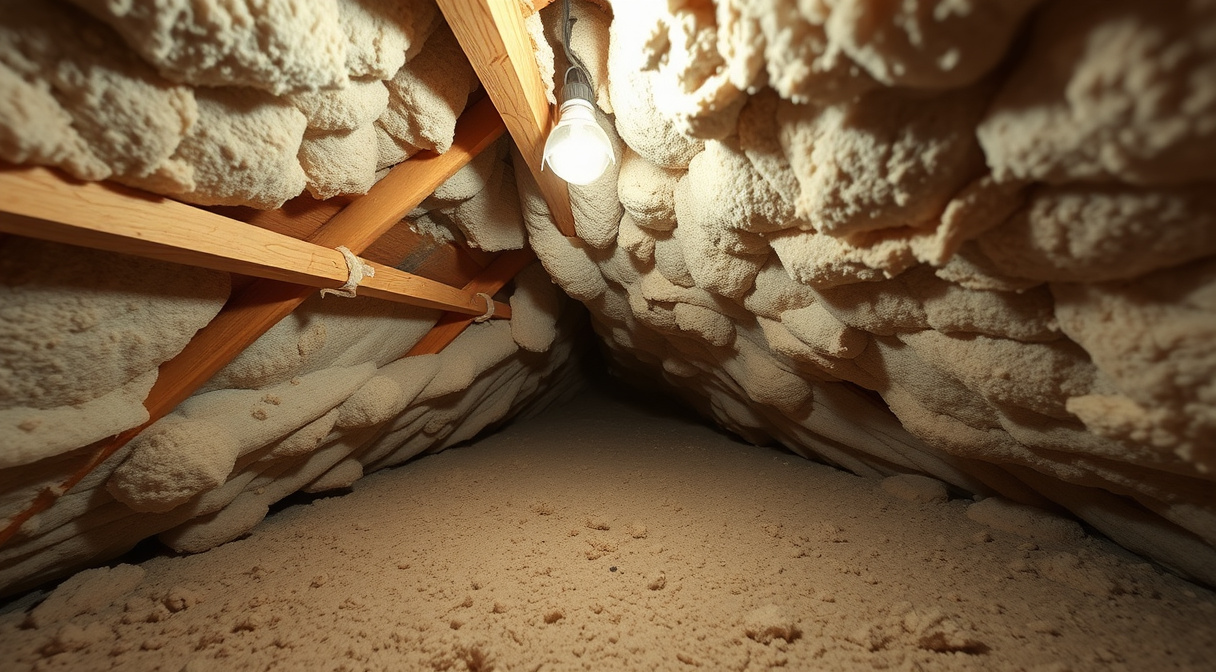
Blown-in insulation is a loose-fill material — either fiberglass or cellulose — that's mechanically blown into an attic floor, wall cavity, or other space using a hose connected to an insulation blower machine. Unlike spray foam, there's no chemical reaction and no expansion; the material's insulating value comes purely from trapping pockets of still air between millions of small fibers or particles.
Fiberglass Blown-In
Blown fiberglass is made of fine glass fibers, similar to what's used in batt insulation but broken into loose, fluffy strands. It's non-combustible, doesn't absorb much moisture, and is generally the lower-cost option between the two loose-fill materials. It typically lands around R-2.2 to R-2.7 per inch, depending on installed density.
Cellulose Blown-In
Cellulose is made from recycled paper fiber (mostly newsprint) treated with borate-based chemicals for fire and pest resistance. It's denser than blown fiberglass, which gives it slightly better sound-dampening and a marginally higher R-value per inch — typically around R-3.2 to R-3.8 — plus it does a somewhat better job of filling around obstructions like wiring and blocking because the dense fiber settles into gaps more completely than fluffy fiberglass strands.
R-Value Per Inch: The Real Numbers
R-value measures resistance to conductive heat flow — higher numbers mean better insulating performance per inch of material. Here's how the four common materials stack up, using typical published ranges:
- Closed-cell spray foam: R-6 to R-7 per inch
- Open-cell spray foam: R-3.5 to R-3.7 per inch
- Blown-in cellulose: R-3.2 to R-3.8 per inch
- Blown-in fiberglass: R-2.2 to R-2.7 per inch
In practical terms, that means closed-cell spray foam can hit a given R-value target in roughly half the physical thickness that blown-in fiberglass needs. That matters most in shallow cavities — rim joists, cathedral ceilings, and 2x4 wall cavities — where there simply isn't room to stack enough loose-fill material to hit a meaningful R-value. In a wide-open attic floor with unlimited depth to work with, the per-inch difference matters less, because you can simply blow in more material to reach the target.
Air Sealing: The Difference That Actually Moves the Needle on Bills
This is, in our experience, the single most misunderstood part of the spray foam vs. blown-in conversation — and it's the one that has the biggest real-world impact on energy bills. R-value measures resistance to conduction, the slow transfer of heat through a solid material. It says nothing about air leakage, which is heat loss (or gain) from air physically moving through gaps, cracks, and penetrations. In a typical older home, air leakage can account for a large share of total energy loss — often rivaling or exceeding conductive loss through under-insulated surfaces.
Spray foam air-seals as a direct consequence of how it's applied. Because it expands to fill irregular gaps and adheres to the surrounding framing, a spray foam application closes the small air pathways around wiring holes, top plates, and framing seams at the same time it's adding R-value. No separate air-sealing step is required in the treated cavity.
Blown-in insulation does not do this. Loose-fill material settles over the top of (or around) whatever air leaks already exist in a floor or ceiling assembly — it doesn't close them. That's why a proper blown-in insulation job should always start with a dedicated air-sealing pass (caulk, foam sealant, or rigid air barriers at penetrations, top plates, and can lights) before the loose-fill material goes in. Skip that step, and you can end up with a technically "well-insulated" attic that still loses a meaningful amount of heat to convection and air movement.
Cost Comparison: What to Actually Expect
Costs vary significantly by region, home layout, accessibility, and current market pricing for materials and labor, so treat the following as general, typical ranges rather than a quote. Always get a written, itemized estimate for your specific project.
- Blown-in fiberglass: generally the lowest cost per square foot of the four options, often the go-to for straightforward attic-floor top-ups.
- Blown-in cellulose: modestly higher than fiberglass per square foot, reflecting the denser material and typically better fill performance.
- Open-cell spray foam: a noticeably higher cost per square foot than either blown-in option, reflecting the material cost, equipment, and skilled labor involved in a chemical spray application.
- Closed-cell spray foam: the highest cost per square foot of the four, but also the highest R-value per inch and the only one of the four that adds meaningful structural rigidity and moisture resistance to the assembly.
The way to think about cost isn't just dollars per square foot in isolation — it's cost relative to what the material is actually accomplishing in that specific cavity. Spending more per square foot on closed-cell foam in a rim joist that previously had zero insulation and constant air infiltration can pay back faster than the raw price difference suggests, because you're solving an air-leakage problem that blown-in insulation physically cannot solve in that location. Conversely, paying a premium for spray foam across a wide-open, easily air-sealed attic floor may not be the most cost-effective use of the budget when a well-air-sealed blown-in job can hit a strong R-value at a lower total cost.
If cost is a major factor, it's also worth asking about combination approaches — for example, air sealing plus a modest layer of closed-cell foam at penetrations and the attic perimeter, topped with blown-in cellulose or fiberglass to build up bulk R-value affordably across the open field. This hybrid strategy is common in real-world attic retrofits precisely because it uses each material where it performs best.
Longevity: Does It Hold Its Performance Over Time?
This is where the two categories diverge the most, and it's a factor that's easy to overlook when comparing initial quotes.
Spray Foam Longevity
Cured spray foam is a rigid or semi-rigid solid that's chemically bonded to the substrate. It doesn't settle, compress under its own weight, or lose loft over time the way loose-fill materials can. Properly installed spray foam is generally expected to maintain its R-value and air-sealing performance for the life of the building, assuming it isn't physically damaged (for example, by roof leaks, rodents chewing through it, or renovation work cutting into it).
Blown-In Longevity
Loose-fill insulation is more vulnerable to gradual performance loss. Cellulose, being a denser, heavier material, can settle over years to decades — meaning the installed depth (and therefore R-value) at the ten- or twenty-year mark may be measurably lower than the depth on install day, especially if it wasn't installed to the manufacturer's settled-density specification. Fiberglass settles less than cellulose but can lose loft if it gets compressed (foot traffic in the attic, stored boxes, HVAC work) or if it becomes damp and then dries, matting the fibers together. Both materials are also vulnerable to being displaced by attic airflow, wind-washing near soffit vents, and rodent activity, which can create thin spots or bare patches over time.
Best Use Case by Area of the Home
Attics (Open Floor)
A wide-open, accessible attic floor is one of the best-suited spaces for blown-in insulation. There's usually enough vertical clearance to hit strong R-value targets with loose-fill material, and the flat, open geometry makes it fast and cost-effective to install at scale. The key is pairing it with a real air-sealing pass first — top plates, can lights, plumbing and wiring penetrations, and the attic hatch itself. Spray foam is also used in attics, particularly for cathedral or vaulted ceilings and unvented ("conditioned") attic assemblies where the roof deck itself is being insulated directly, since there's often limited depth and a need for both air sealing and moisture control against the roof sheathing.
Rim Joists
Rim joists — the band of framing that sits atop the foundation wall around the perimeter of a floor system — are one of the most common uncontrolled air-leak points in a home, and they're a textbook case for closed-cell spray foam. The cavity is shallow, irregular, and full of small gaps around joist ends, making it nearly impossible for blown-in material to seal effectively. A few inches of closed-cell foam sprayed directly against the rim joist band both air-seals and insulates the space in one pass.
Crawl Spaces
Crawl spaces present a moisture challenge that changes the calculus. Closed-cell spray foam is often preferred here — either applied to the underside of the subfloor or, in an encapsulated crawl space approach, to the foundation walls — because it resists moisture absorption and won't wick water the way some loose-fill and batt products can. Blown-in insulation is generally a poor fit for crawl space walls and is rarely recommended for that application, since ground moisture and periodic dampness are common realities in an unconditioned crawl space.
Walls
In new construction or a full gut renovation with open wall cavities, both open-cell and closed-cell spray foam are strong options, delivering air sealing and insulation together in a cavity that's otherwise hard to air-seal once it's closed up. Blown-in insulation is also used in walls, primarily in a retrofit "dense-pack" application through small drilled holes in existing finished walls — a common and effective way to add insulation to an older home without opening up the drywall, though it depends on skilled installation to reach the density needed to prevent settling inside a closed cavity.
Moisture and Pest Resistance
Closed-cell spray foam's rigid, tightly packed cell structure makes it naturally resistant to water absorption, which is a major reason it's favored in basements, crawl spaces, and other areas with elevated moisture exposure. Open-cell foam is more vapor-permeable and can absorb water if it gets wet, so it's typically avoided in below-grade or high-moisture applications unless paired with the right vapor strategy.
Cellulose insulation is treated with borate compounds during manufacturing, which gives it a genuine deterrent effect against insects and rodents, and also functions as a fire retardant. That said, if cellulose gets wet and stays wet, it can hold moisture, mat down, and become a environment where mold can take hold — which is why proper air sealing, roof and plumbing maintenance, and adequate attic ventilation all matter regardless of which material you choose. Fiberglass doesn't absorb much moisture itself, but a wet, matted layer of fiberglass sitting against damp wood framing doesn't solve the underlying moisture problem either — it just doesn't feed it directly.
A Simple Decision Framework
When you're staring at a bid sheet trying to decide, run through these questions:
- Is the space irregular, shallow, or full of penetrations (rim joists, cathedral ceilings, crawl space walls)? Lean toward spray foam — it's the only one of the two that reliably air-seals a complex cavity.
- Is it a large, open, accessible attic floor with plenty of depth to work with? Blown-in insulation (properly air-sealed first) is often the more cost-effective path to a strong R-value.
- Is moisture exposure a real concern (below grade, crawl space, coastal or humid climate)? Closed-cell spray foam's water resistance is a meaningful advantage.
- Is budget the primary constraint and the space is otherwise straightforward? Blown-in fiberglass or cellulose, installed correctly with air sealing done first, delivers strong value.
- Do you have chronic drafts, uneven room temperatures, or high energy bills despite "enough" insulation? That's usually an air-sealing problem more than an R-value problem — spray foam addresses both at once.
In many real homes, the right answer isn't "spray foam everywhere" or "blown-in everywhere" — it's a combination: closed-cell foam at the rim joists and other tricky air-leak points, and a well-air-sealed blown-in attic floor for the bulk of the thermal envelope. A contractor who's willing to talk through that kind of hybrid approach, rather than pushing one material for the entire job, is usually giving you better advice than one who isn't.
Getting a Real Answer for Your Home
Every home is a different combination of framing, climate exposure, existing insulation condition, and budget — which is exactly why this guide gives you ranges and a framework instead of a single one-size-fits-all recommendation. The fastest way to get a precise answer for your specific house is a walkthrough with a contractor who will actually inspect the attic, rim joists, crawl space, and wall assemblies before quoting a fix, rather than pricing a job sight-unseen. Call us at 844-967-5247 or email josh@contractorschoiceagency.com to talk through what's going on in your home and get a straight recommendation on which material — or which combination — makes sense for your space and your budget.
Frequently asked questions
Yes, and in practice this is very common. A typical hybrid approach uses closed-cell spray foam at rim joists, penetrations, and other hard-to-seal spots, combined with blown-in fiberglass or cellulose across open attic floor space. Each material is doing the job it's best suited for rather than trying to make one product handle every condition in the house.
Not automatically. Spray foam's premium is best justified in spaces where air sealing is the real problem — rim joists, cathedral ceilings, crawl spaces — or where cavity depth is too shallow for loose-fill material to hit a meaningful R-value. In a large, open attic floor that can be properly air-sealed first, well-installed blown-in insulation can be a very cost-effective way to hit strong R-value targets.
Not necessarily replaced, but it should be inspected periodically. Cellulose can settle over years to decades, and both fiberglass and cellulose can lose performance from compression, moisture exposure, or wind-washing near vents. If your blown-in insulation is more than 15-20 years old, or you've never had the depth checked, it's worth having a professional assess current R-value versus what's needed.
The federal 25C energy-efficiency tax credit (which covered qualifying insulation upgrades) expired December 31, 2025. Depending on where you live, state and utility-level rebate programs may still be available — check current programs in your area, since these vary and change independently of federal policy.
Ready for a free quote?
Tell us about your home and we'll build a clear quote — rebates included.